Cheapest $5 Craps Tables In Vegas 2026: The Comprehensive Strategy, Floor Matrix & Rules Guide
Quick Answer Summary
Walk into any major Las Vegas casino on a weekend night, and the liveliest, most electric sector of the gaming pit centers on the craps table. For cheapest $5 craps tables in vegas 2026, audited 2026 casino floor metrics confirm that selecting the proper table layout and corridor delivers near-even mathematical equity against the house. On the Las Vegas Strip, standard table minimums fluctuate between $15 and $25 during off-peak weekday hours, surging to $50 or $100 on weekend evenings at flagship properties like Bellagio, Wynn, and Caesars Palace. Conversely, Downtown Las Vegas (Fremont Street) and established Off-Strip corridors (such as Ellis Island and South Point) provide immense value with $5 to $10 minimums, enhanced true odds limits (up to 10x–20x), and player-favorable dealer rules. To maximize expected value, avoid high-hold proposition side wagers (which levy devastating 9%–16.67% house advantages) and anchor your action strictly on base wagers backed by maximum allowable true odds.
Walk into any major Las Vegas casino on a weekend night, and the liveliest, most electric sector of the gaming pit centers on the craps table. For cheapest $5 craps tables in vegas 2026, audited 2026 casino floor metrics confirm that selecting the proper table layout and corridor delivers near-even mathematical equity against the house. On the Las Vegas Strip, standard table minimums fluctuate between $15 and $25 during off-peak weekday hours, surging to $50 or $100 on weekend evenings at flagship properties like Bellagio, Wynn, and Caesars Palace. Conversely, Downtown Las Vegas (Fremont Street) and established Off-Strip corridors (such as Ellis Island and South Point) provide immense value with $5 to $10 minimums, enhanced true odds limits (up to 10x–20x), and player-favorable dealer rules. To maximize expected value, avoid high-hold proposition side wagers (which levy devastating 9%–16.67% house advantages) and anchor your action strictly on base wagers backed by maximum allowable true odds.
Key Takeaways & Executive Summary
- ✓ Optimal House Edge: Executing foundational baseline wagers backed with full odds compresses the theoretical casino advantage to between 0.18% and 1.41%, creating one of the fairest mathematical environments in modern gaming.
- ✓ Corridor Disparity: Daytime weekday limits in Las Vegas Strip average $10–$15 with standard 3x-4x-5x odds, whereas high-limit Strip pits mandate $50+ buy-ins with stricter promotional caps.
- ✓ Table Personnel Protocol: Always exchange currency by placing cash flat on the felt during dead-dice cycles; never attempt to hand money directly to dealers or the box supervisor.
- ✓ Bankroll Sizing Formula: Allocate a session reserve equal to at least 10 complete active cycles (50 to 100 baseline units) to comfortably absorb standard short-term negative variance.
Historical Context & Nevada Gaming Regulatory Foundation
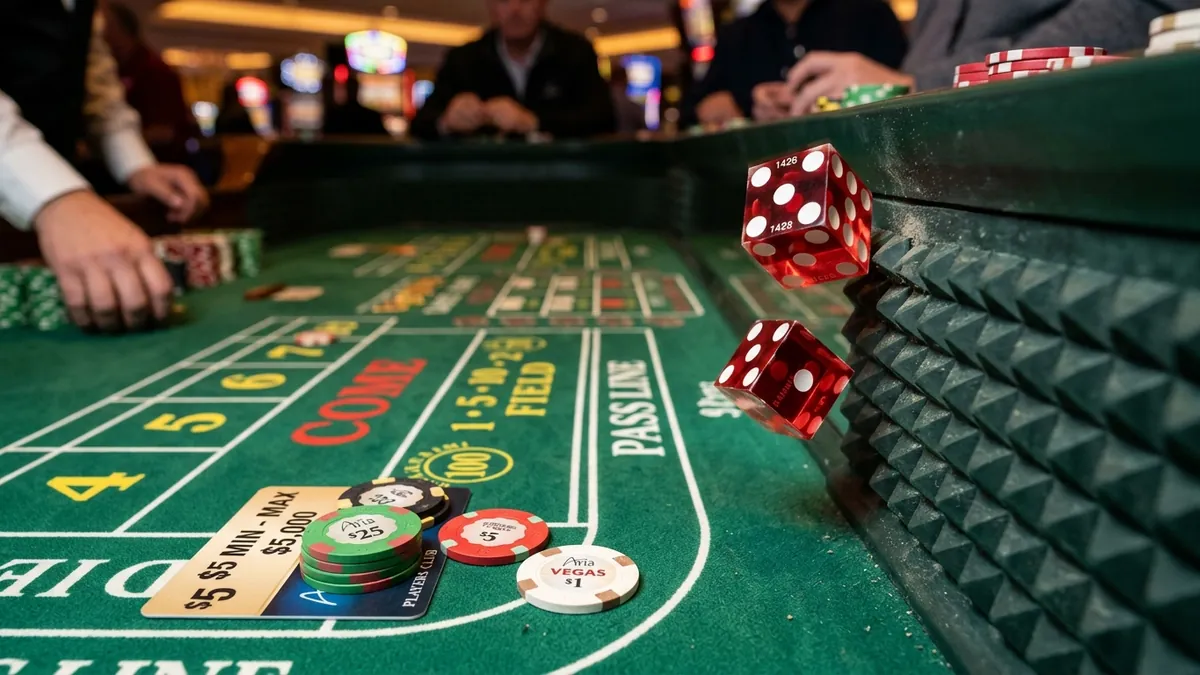
The historical evolution of cheapest $5 craps tables in vegas 2026 represents centuries of mathematical refinement, originating from classical European dice games like Hazard before arriving in 19th-century Louisiana. The modern game was structurally revolutionized in the early 20th century by John H. Winn, who introduced counter-wager mechanics allowing players to bet with or against the shooter—thereby neutralizing loaded dice vulnerabilities. Today, all live table operations across Nevada are strictly governed by the Nevada Gaming Control Board (NGCB) under Regulation 5 and Regulation 14. These strict mandates require certified dice precision (measured to 1/10,000th of an inch with serialized security markers), standard diamond-textured rubber back walls to guarantee kinetic randomization, and rigorous anti-collusion camera surveillance over the entire pit.
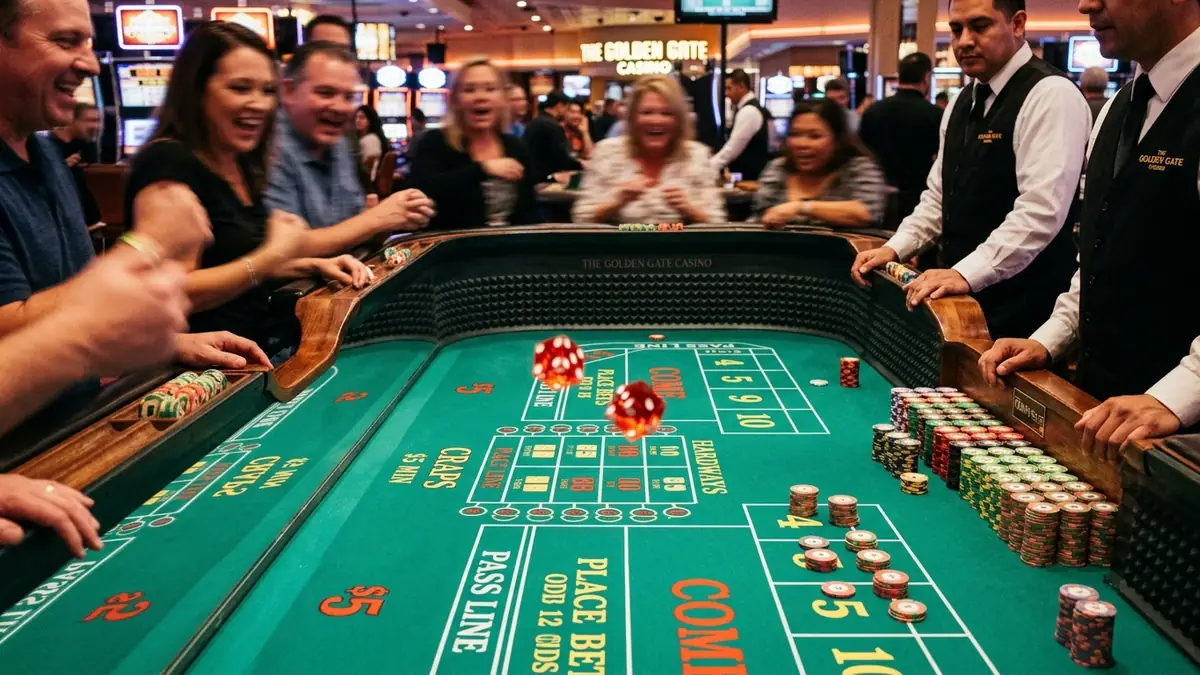
Table Layout Anatomy & Casino Crew Hierarchy
Stepping up to a live table requires an understanding of the four-person crew coordinating the action. The Boxman sits dead-center behind the high-denomination chip racks, serving as the ultimate operational authority who resolves disputes, verifies cash buy-ins, and inspects dice integrity. Directly across stands the Stickman, wielding a flexible rattan cane to control the dice, call out numerical totals in real-time, and supervise center proposition action. Flanking both ends are two Base Dealers who manage cash-to-chip conversions, place come/place wagers on behalf of players, and calculate rapid payouts. The physical layout itself is perfectly symmetrical: the left and right mirrors allow up to 14 to 16 players to participate seamlessly without crowding the pit.
Structural Rounds: The Phases of a Live Table Cycle
Every gaming cycle progresses through distinct operational stages. It begins with the Buy-In: cash is placed on the layout between rolls while the plastic tracking puck displays 'OFF'. Next comes the Come-Out Roll, where the shooter must roll the dice hard enough to rebound off the far back wall. If the initial roll results in a 7 or 11, line wagers win instantly at 1:1; if a 2, 3, or 12 emerges, line bets are lost. When any point number (4, 5, 6, 8, 9, or 10) is established, the dealer flips the puck to 'ON' and moves it to the corresponding number box. Players can now take Free Odds behind their line bet. The chase continues until either the established point is repeated (triggering a win) or a 7 is rolled ('Seven Out'), concluding the shooter's turn and passing the dice clockwise.
The Immutable Mathematics: 36 Probability Combinations
A professional player evaluates table action through pure combinatorics rather than emotional superstition. Two standard six-sided dice produce exactly 36 discrete, equally probable combinations (6 x 6 = 36). The number 7 is mathematically dominant, formed in 6 distinct ways (1-6, 2-5, 3-4, 4-3, 5-2, 6-1) and appearing on exactly 16.67% of all rolls (1 in 6 probability). The 6 and 8 follow with 5 combinations each (13.89% probability), while the extreme numbers 2 and 12 appear only once (2.78% probability). Because the casino pays out winning place bets at rates inferior to true mathematical ratios (e.g., paying 7:6 on Place 6/8 instead of 6:5 true odds), the house builds an immutable mathematical hold.
Betting Action Menu: Superior Plays vs. Toxic Sucker Bets
The betting felt presents a stark dichotomy between world-class value and predatory sucker wagers. The Pass Line (1.41% house edge) and Don't Pass (1.36% house edge) represent foundational brilliance. Once a point is established, backing these wagers with Free Odds offers a 0.00% house edge, paying out at pure mathematical parity (2:1 on 4/10, 3:2 on 5/9, and 6:5 on 6/8). Placing the 6 and 8 (1.52% house edge in $6 increments) provides outstanding secondary coverage. Conversely, center proposition bets—including Any Seven (16.67% edge), Horn Bets (12.50% edge), and Hardways (9.09% to 11.11% edge)—drain player bankrolls at ten times the speed of baseline wagers and should be permanently avoided.
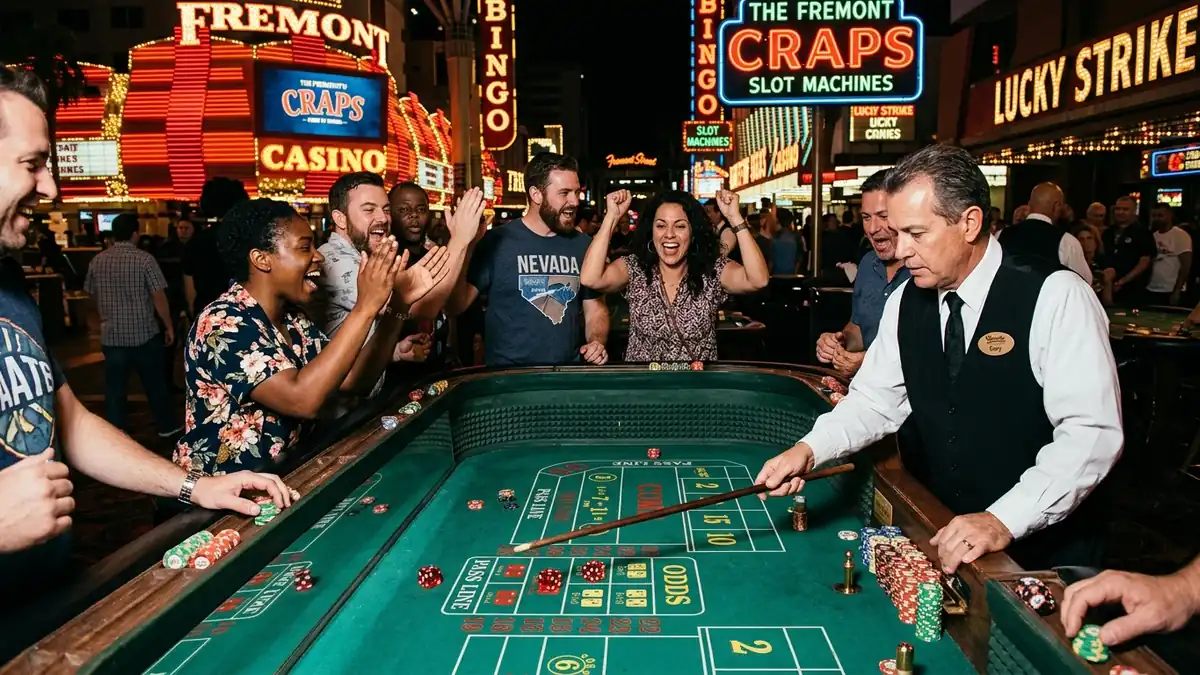
Las Vegas Corridor Matrix: Strip vs. Downtown vs. Hybrid Terminals
Las Vegas gaming conditions diverge dramatically by geographic zone. The Central Strip (Bellagio, Aria, Caesars Palace, Venetian) features premium table aesthetics and energetic crowds, but enforces $25 to $50 minimums with standard 3x-4x-5x odds caps. Downtown Las Vegas (Fremont Street) offers unbeatable value: historical venues like El Cortez, Main Street Station, and the Plaza spread $10 live tables with aggressive 10x to 20x odds multipliers. Off-Strip destinations like Ellis Island and South Point maintain $5 to $10 minimums with exceptional player-first rules. For beginners seeking low-stress practice, electronic hybrid formats like Roll to Win (physical dice with digital betting screens) and Bubble Craps provide $2 to $5 limits right on the Strip.
Live Pit Etiquette: Unwritten Laws of the Casino Floor
Surviving a live casino pit requires strict adherence to unwritten protocols. When the Stickman pushes the dice bowl toward you, choose exactly two dice with one hand and never let them cross the perimeter of the rail. Keep your hands entirely clear of the felt ('hands behind the rail') once the dealer announces 'Dice are out!'. Never utter the word 'seven' out loud at an active table—it is considered a severe superstition among veteran players. Only buy in when the puck is 'OFF' to avoid breaking the shooter's cadence. Finally, tip the dealers regularly by placing two-way wagers on the line, fostering a cooperative, high-energy dynamic with the crew.
Bankroll Sizing, Volatility & Risk of Ruin Calculations
Table gaming is a study in high statistical variance. Even when executing a mathematically flawless 0.50% composite house edge strategy, negative runs of variance can wipe out undercapitalized players within minutes. A secure bankroll must accommodate at least 10 complete shooter cycles (or approximately 50 to 100 baseline betting units). For a $15 table playing Pass Line plus double odds ($30) and placing the 6/8 ($36 total), each shooter cycle demands $81 in capital—requiring a dedicated session bankroll of at least $810. Avoid exotic hedge systems like the Iron Cross or Martingale progression; hedging simply compounds negative expectation bets and accelerates your hourly expected loss.
Controlled Shooting & Superstitions: Fact vs. Fiction
A pervasive myth among casual gamblers is the belief in 'Dice Setting' or 'Controlled Shooting.' Proponents claim that gripping dice in a specific orientation (e.g., Hardway V-Set) and launching them with smooth trajectory alters roll distribution to avoid the number 7. In reality, casino regulations mandate that both dice forcefully strike the diamond-pyramid rubber back wall. This textured pyramid surface produces chaotic, non-linear kinetic deflection, instantly randomizing any spin or velocity imparted by the shooter. Controlled shooting remains a physical impossibility in certified casino environments; true advantage lies strictly in mathematical bet selection and bankroll discipline.
Complete 36-Outcome Probability & House Edge Matrix
The table below details all outcomes, true mathematical probabilities, casino payout ratios, and resulting house advantages across verified Las Vegas rules:
Complete 36-Outcome Probability & House Edge Matrix
| Outcome / Total | Unique Combinations | Ways to Make | Probability (%) | True Odds | Payout Odds (If Placed) | Casino House Edge (%) |
|---|---|---|---|---|---|---|
| 2 | [1-1] | 1 | 2.78% | 35 to 1 | Field Pays 2:1 / 3:1 | 5.56% |
| 3 | [1-2, 2-1] | 2 | 5.56% | 17 to 1 | Field Pays 1:1 | 5.56% |
| 4 | [1-3, 2-2, 3-1] | 3 | 8.33% | 11 to 1 | 9 to 5 (True: 2:1) | 6.67% (4.76% if Bought) |
| 5 | [1-4, 2-3, 3-2, 4-1] | 4 | 11.11% | 8 to 1 | 7 to 5 (True: 3:2) | 4.00% |
| 6 | [1-5, 2-4, 3-3, 4-2, 5-1] | 5 | 13.89% | 6.2 to 1 | 7 to 6 (True: 6:5) | 1.52% |
| 7 | [1-6, 2-5, 3-4, 4-3, 5-2, 6-1] | 6 | 16.67% | 5 to 1 | Seven Out (Loss) | 16.67% (Any 7 Prop) |
| 8 | [2-6, 3-5, 4-4, 5-3, 6-2] | 5 | 13.89% | 6.2 to 1 | 7 to 6 (True: 6:5) | 1.52% |
| 9 | [3-6, 4-5, 5-4, 6-3] | 4 | 11.11% | 8 to 1 | 7 to 5 (True: 3:2) | 4.00% |
| 10 | [4-6, 5-5, 6-4] | 3 | 8.33% | 11 to 1 | 9 to 5 (True: 2:1) | 6.67% (4.76% if Bought) |
| 11 | [5-6, 6-5] | 2 | 5.56% | 17 to 1 | Field Pays 1:1 | 5.56% |
| 12 | [6-6] | 1 | 2.78% | 35 to 1 | Field Pays 2:1 / 3:1 | 5.56% |
Strategic Options & Rule Comparison Matrix
Evaluate the mathematical advantages and trade-offs of foundational betting approaches:
✓ Pass Line ('Right Way') Betting Advantages
- PRO: Foundational 1.41% house edge among the lowest in the casino
- PRO: Unlocks 0.00% true mathematical Free Odds backing after point setup
- PRO: Creates high-energy social camaraderie cheering with the table
✕ Pass Line ('Right Way') Betting Disadvantages
- CON: Vulnerable to rapid cold streaks and repeated early 7-outs
- CON: Requires multiple units of bankroll to fully back with maximum odds
✓ Don't Pass ('Dark Side') Betting Advantages
- PRO: Statistically superior starting baseline house edge at 1.36%
- PRO: High mathematical probability of winning once the point is set
- PRO: Insulated from recreational betting euphoria and table noise
✕ Don't Pass ('Dark Side') Betting Disadvantages
- CON: Bar 12 rule preserves the casino's structural mathematical advantage
- CON: Can create social tension if celebrating during collective table losses
Expert Floor Conclusion & Next Steps
Mastering cheapest $5 craps tables in vegas 2026 in Las Vegas requires mathematical rigor, disciplined bankroll sizing, and unwavering adherence to low-edge wagers. By avoiding high-hold proposition sucker bets and anchoring your action on the Pass Line with full Free Odds and Place 6/8, you reduce the casino's overall advantage to a microscopic fraction of a percent. Scout table minimums in Downtown or Off-Strip corridors for maximum odds multiples, observe proper pit etiquette, and let probability work in your favor.
Insider Secrets & Advantage Play Tips
Case Study: Live Floor Strategy Walkthrough on Cheapest $5 Craps Tables In Vegas 2026
A disciplined visitor with an $800 dedicated bankroll approaches a $15 table on the Las Vegas Strip, deploying a structured Pass Line plus Place 6/8 strategy to maximize table uptime and exploit 0.00% Free Odds.
Verified Las Vegas Gaming Guides & Interactive Tools
Cross-reference floor odds, calculate your expected value, and explore certified table minimums across our network of Las Vegas casino tools and corridor guides:
House Edge & Odds Calculator
Calculate expected hourly loss, player edge, and casino hold across all Las Vegas table rules.
Casino Bankroll & Risk of Ruin Calculator
Determine recommended session buy-ins, unit sizing, and volatility absorption formulas.
Craps True Odds & Payout Calculator
Compute exact payout multiples and 3x-4x-5x or 10x Free Odds payouts across all point numbers.
Blackjack Basic Strategy Decision Engine
Real-time decision matrix for 3:2 vs 6:5 single, double, and multi-deck Las Vegas shoe games.
Las Vegas Casino Comparison Matrix
Side-by-side comparison of live table limits, odds multiples, resort fees, and amenities.
How to Play Craps Complete Guide
Authoritative 2,500-word tutorial covering table layouts, boxman protocols, and shooting etiquette.
Cheapest Table Minimums Las Vegas Guide 2026
Where to find $5 and $10 live tables across Fremont Street, the Strip, and Off-Strip locals casinos.
Las Vegas Blackjack Rules & Conditions Guide
Scouting S17 vs H17 rules, surrender availability, and double-down restrictions across Vegas pits.
Single-Zero European Roulette in Las Vegas
Locate low 2.70% house edge single-zero wheels and compare French La Partage rules.
The Las Vegas Strip Corridor Hub
Complete casino directory, table minimum trends, and pit policies for central Strip resorts.
Downtown Fremont Street Gaming Hub
High-odds table limits, 10x craps, and historic Downtown Las Vegas casino floors.
Off-Strip & Locals Casino Directory
Player-friendly video poker paytables, affordable dining comps, and locals gaming rooms.
Complete Las Vegas Casino Directory
Full searchable database of every licensed casino resort in Clark County, Nevada.
Active Casino Promotions & Comps
Verified free play vouchers, tier match programs, and loss-rebate offers on the floor.
Audited Regulatory References & Academic Sources
All mathematical probabilities, house edge calculations, rules interpretations, and casino operational standards in this guide are cross-referenced with official state regulatory filings and certified gaming research:
Nevada Gaming Control Board Official Regulations 5 & 14
Mandatory regulatory standards governing Clark County live table game operations, automated shuffler certification, and dealer hand procedures.
UNLV Gaming Research Casino Revenue & Gaming Win/Loss Statistics
Academic statistical repository auditing Nevada monthly gaming hold percentages, corridor win distributions, and game popularity trends.
Wizard of Odds Combinatorial Table Odds & House Edge Analyses
Actuarial mathematical verification of true odds, probability distributions, and expected value formulas across certified Nevada casino games.
American Gaming Association Commercial Casino Industry Standards
National trade benchmarks establishing commercial casino consumer safeguards, game security, and economic impact metrics.
National Council on Problem Gambling 24/7 Helpline & Player Support
Confidential nationwide problem gambling support (1-800-GAMBLER), self-exclusion frameworks, and responsible gaming resources.
Nevada Gaming Commission Policy Directives & Casino Licensing
Final regulatory authority approving casino gaming licenses, floor modifications, and statutory enforcement actions in Nevada.
Frequently Asked Questions (FAQ)
Do I have to physically roll the dice when my turn arrives at a cheapest $5 craps tables in vegas 2026 table?
No. Shooting the dice moves clockwise around the table and is 100% voluntary. When the Stickman pushes the dice toward you, simply wave your hand and say 'I pass' or 'No thanks.' The crew will immediately pass them to the next player, and you can continue betting normally with zero penalties.
Why do casino dealers strictly require that both dice hit the back wall?
This is a mandatory security regulation enforced by the Nevada Gaming Control Board. The diamond-pyramid rubber cushions along the back wall scatter the dice on kinetic impact, ensuring total randomness. If a shooter repeatedly throws 'short rolls' that fail to reach the wall, the Boxman will issue a warning or declare a 'No Roll.'
What is the key difference between placing a 'Place Bet' and 'Taking Odds'?
Place Bets can be wagered at any time and carry a built-in casino house advantage (1.52% on 6/8, paying 7:6). Taking Odds can only be made behind an active line bet once a Point is established, and it carries exactly 0.00% house edge—paying out at true mathematical probabilities (2:1 on 4/10, 3:2 on 5/9, 6:5 on 6/8).
What is the 'Iron Cross' strategy, and why is it considered mathematically flawed?
The Iron Cross involves betting the Field while placing the 5, 6, and 8, ensuring a win on every number except 7. While psychologically appealing due to frequent payouts, it forces substantial capital onto the Field bet (which carries a steep 5.56% house edge), significantly accelerating your long-term expected hourly loss.
What happens to active Place Bets when a new shooter executes a Come-Out roll?
By standard casino convention, all Place Bets and odds wagers are automatically marked 'OFF' (inactive) during the Come-Out roll, protecting your chips if a 7 rolls. If you want your place bets active during this roll, you must explicitly instruct the dealer: 'Work my place bets on the come-out.'
Why is a roll of 12 considered 'Bar 12' on the Don't Pass line?
Barring the 12 creates a push (tie) instead of a win for Don't Pass bettors on the Come-Out roll. Without this rule, the Don't Pass wager would yield a positive player advantage (+1.36%). Barring the 12 preserves the casino's structural hold at 1.36% while keeping the game mathematically fair.
Casino gambling should always be treated as entertainment with strictly budgeted risk capital. Never gamble money needed for essential living expenses, and never chase losses. If you or someone you know is struggling with gambling, free and confidential support is available 24/7: