Where to Find 3:2 Blackjack Under $15 on the Las Vegas Strip
Quick Answer Summary
Finding 3:2 blackjack for under $15 on the The Las Vegas Strip is increasingly rare, as most properties have migrated to 6:5 payouts on low-limit tables. While the Las Vegas Strip is dominated by 6:5, savvy players can occasionally find 3:2 games at properties like Treasure Island or Sahara during off-peak hours. Always verify the payout on the felt before sitting, as the House Edge Calculator shows that 6:5 payouts increase the house edge by approximately 1.39%, significantly impacting your expected return.
Finding 3:2 blackjack under $15 on the The Las Vegas Strip is difficult due to the widespread adoption of 6:5 payouts. Players should scout properties like Sahara or Treasure Island during weekday mornings. Always check the felt for 'Blackjack pays 3 to 2' before buying in, as 6:5 games drastically increase the house edge and deplete bankrolls faster.
Key Takeaways & Executive Summary
- ✓ Payout Reality: 3:2 pays $15 on a $10 bet; 6:5 pays only $12.
- ✓ House Edge Impact: 6:5 rules add roughly 1.39% to the house edge.
- ✓ Scouting Location: Check the felt; if it doesn't say 3:2, it is almost certainly 6:5.
- ✓ Bankroll Buffer: A 100-unit bankroll is the minimum for survival.
The Mathematical Disparity: 3:2 vs 6:5
The payout ratio is the single most critical factor in your expected return. A 3:2 payout means a $10 bet returns $15 on a blackjack. A 6:5 payout returns only $12. This 1.39% increase in house edge is not a minor detail; it is a fundamental change in the game's math. According to data from the UNLV Center for Gaming Research, this rule change has become standard across the Strip to increase hold percentages. Players must use a House Edge Calculator to understand that playing 6:5 is essentially paying a premium for the privilege of losing money faster.
Scouting the Strip Corridor
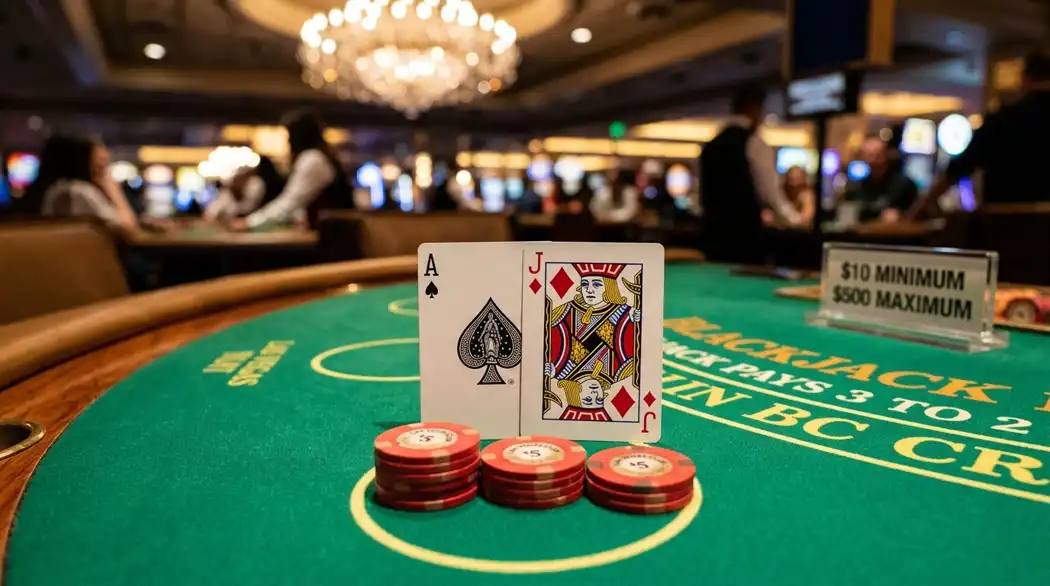
The Las Vegas Strip is a high-overhead environment. Casinos here prioritize revenue per square foot, which is why 6:5 has become the default for low-limit tables. To find 3:2, you must look at properties that cater to a mix of locals and tourists, such as Sahara or Treasure Island. Do not assume a $15 table is 3:2; in 2026, many $15 tables are strictly 6:5. Always verify the felt. If it doesn't explicitly state 'Blackjack pays 3 to 2,' assume it is 6:5 and move on.
The Importance of Table Rules (S17 vs H17)
Beyond the payout, the dealer's rules on soft 17 significantly impact the game. A dealer standing on soft 17 (S17) is the standard for a fair game. If the dealer hits soft 17 (H17), the house edge increases by approximately 0.22%. When scouting for 3:2 games, prioritize S17 tables. You can find these rules posted on a small placard on the table. If you are unsure, ask the dealer before placing your bet. Understanding these nuances is key to maintaining a Responsible Gambling approach.
Bankroll Management for Low-Limit Players
Even at $10 or $15 tables, variance is real. A common mistake is arriving with a bankroll that is too small to absorb a losing streak. For a $10 table, a $500 bankroll is a bare minimum. Use a Bankroll Calculator to determine your session limits. If you lose 50 units, you should have the discipline to walk away. The goal is to play optimally, not to chase losses. Remember, the casino has a mathematical advantage; your only defense is disciplined play and game selection.

The Role of Double After Split (DAS)
Double After Split (DAS) is a player-friendly rule that allows you to double down after splitting a pair. It reduces the house edge by about 0.14%. When you find a rare 3:2 table on the Strip, check if DAS is allowed. If it is, you have found a significantly better game than the standard 6:5 tables found elsewhere. This rule is often omitted in 6:5 games, further widening the gap in player return.
Etiquette and Pit Procedures
When playing at low-limit tables, etiquette is paramount. Never touch the cards in a shoe-dealt game. Use hand signals: tap the table for a hit, wave your hand for a stand. If you are unsure about the rules, ask the dealer. Pit bosses appreciate players who know the game and play at a steady pace. Being polite and professional can sometimes lead to better service, though it will not change the house edge.

Regulatory Oversight and Transparency
In Nevada, casinos are required to post the rules of the game. The Nevada Gaming Control Board (NGCB) ensures that payouts are clearly marked. If a table does not have the payout clearly visible, it is a violation of standard operating procedures. You have the right to ask for clarification. Always trust the printed rules on the table over what a floor person might tell you verbally.
The Off-Strip Alternative
If you cannot find 3:2 blackjack on the Strip for under $15, consider venturing to Off-Strip & Locals properties or Downtown Fremont. Properties like the El Cortez are famous for their player-friendly rules and lower minimums. While the atmosphere is different from the mega-resorts, the mathematical return is often superior. It is a trade-off between luxury and value.
Variance and the Long Run
Blackjack is a game of short-term variance. You can win at a 6:5 table in the short term, just as you can lose at a 3:2 table. However, in the long run, the math always wins. By consistently choosing 3:2 games, you are minimizing the house's advantage and maximizing your time at the table. This is the essence of smart gambling.
Blackjack Rules & Expected Return Matrix
The table below details all outcomes, true mathematical probabilities, casino payout ratios, and resulting house advantages across verified Las Vegas rules:
Blackjack Rules & Expected Return Matrix
| Rule Set | Payout | House Edge | Min Bet | Verdict |
|---|---|---|---|---|
| 3:2, S17, DAS | 3:2 | ~0.40% | $15+ | Excellent |
| 3:2, H17, DAS | 3:2 | ~0.60% | $15+ | Good |
| 6:5, H17, No DAS | 6:5 | ~2.00%+ | $10-$15 | Avoid |
Strategic Options & Rule Comparison Matrix
Evaluate the mathematical advantages and trade-offs of foundational betting approaches:
✓ Playing 3:2 Tables Advantages
- PRO: Lower house edge (approx 0.4-0.6%)
- PRO: Better long-term value
- PRO: Standard rules
✕ Playing 3:2 Tables Disadvantages
- CON: Higher minimums
- CON: Harder to find on the Strip
- CON: Crowded during peak hours
✓ Playing 6:5 Tables Advantages
- PRO: Easier to find
- PRO: Lower minimums
- PRO: Available at most resorts
✕ Playing 6:5 Tables Disadvantages
- CON: High house edge (2%+)
- CON: Mathematically disadvantageous
- CON: Depletes bankroll faster
Casino Floor Decision & Scouting Checklist
Review this actionable verification checklist before sitting down at any live table or executing a betting session:
Expert Floor Conclusion & Next Steps
Finding 3:2 blackjack under $15 on the Strip is a challenge that requires patience and scouting. Always prioritize the payout over the table minimum. Use the House Edge Calculator to understand the math, and remember that your best defense against the house is disciplined play. If the Strip fails you, don't hesitate to explore Downtown Fremont for better rules.
Insider Secrets & Advantage Play Tips
Case Study: Real-World Floor Bankroll Walkthrough
A player with a $500 bankroll enters a Strip casino looking for a 3:2 game. They find a $15 minimum table.
Verified Las Vegas Gaming Guides & Interactive Tools
Cross-reference floor odds, calculate your expected value, and explore certified table minimums across our network of Las Vegas casino tools and corridor guides:
House Edge & Odds Calculator
Calculate expected hourly loss, player edge, and casino hold across all Las Vegas table rules.
Casino Bankroll & Risk of Ruin Calculator
Determine recommended session buy-ins, unit sizing, and volatility absorption formulas.
Craps True Odds & Payout Calculator
Compute exact payout multiples and 3x-4x-5x or 10x Free Odds payouts across all point numbers.
Blackjack Basic Strategy Decision Engine
Real-time decision matrix for 3:2 vs 6:5 single, double, and multi-deck Las Vegas shoe games.
Las Vegas Casino Comparison Matrix
Side-by-side comparison of live table limits, odds multiples, resort fees, and amenities.
How to Play Craps Complete Guide
Authoritative 2,500-word tutorial covering table layouts, boxman protocols, and shooting etiquette.
Cheapest Table Minimums Las Vegas Guide 2026
Where to find $5 and $10 live tables across Fremont Street, the Strip, and Off-Strip locals casinos.
Las Vegas Blackjack Rules & Conditions Guide
Scouting S17 vs H17 rules, surrender availability, and double-down restrictions across Vegas pits.
Single-Zero European Roulette in Las Vegas
Locate low 2.70% house edge single-zero wheels and compare French La Partage rules.
The Las Vegas Strip Corridor Hub
Complete casino directory, table minimum trends, and pit policies for central Strip resorts.
Downtown Fremont Street Gaming Hub
High-odds table limits, 10x craps, and historic Downtown Las Vegas casino floors.
Off-Strip & Locals Casino Directory
Player-friendly video poker paytables, affordable dining comps, and locals gaming rooms.
Complete Las Vegas Casino Directory
Full searchable database of every licensed casino resort in Clark County, Nevada.
Active Casino Promotions & Comps
Verified free play vouchers, tier match programs, and loss-rebate offers on the floor.
Audited Regulatory References & Academic Sources
All mathematical probabilities, house edge calculations, rules interpretations, and casino operational standards in this guide are cross-referenced with official state regulatory filings and certified gaming research:
Nevada Gaming Control Board Official Regulations 5 & 14
Mandatory regulatory standards governing Clark County live table game operations, automated shuffler certification, and dealer hand procedures.
UNLV Gaming Research Casino Revenue & Gaming Win/Loss Statistics
Academic statistical repository auditing Nevada monthly gaming hold percentages, corridor win distributions, and game popularity trends.
Wizard of Odds Combinatorial Table Odds & House Edge Analyses
Actuarial mathematical verification of true odds, probability distributions, and expected value formulas across certified Nevada casino games.
American Gaming Association Commercial Casino Industry Standards
National trade benchmarks establishing commercial casino consumer safeguards, game security, and economic impact metrics.
National Council on Problem Gambling 24/7 Helpline & Player Support
Confidential nationwide problem gambling support (1-800-GAMBLER), self-exclusion frameworks, and responsible gaming resources.
Nevada Gaming Commission Policy Directives & Casino Licensing
Final regulatory authority approving casino gaming licenses, floor modifications, and statutory enforcement actions in Nevada.
Frequently Asked Questions (FAQ)
Is 6:5 blackjack ever worth playing?
Mathematically, no. The house edge is significantly higher. It should only be played for entertainment purposes if you cannot find a 3:2 game and are willing to pay the 'premium' for the convenience of playing at a specific resort.
How do I know if a table is 6:5?
Look at the felt. It will usually say 'Blackjack pays 6 to 5.' If it doesn't say anything, ask the dealer. If they say 6:5, walk away.
Are there any $5 blackjack tables left on the Strip?
Extremely rare. You might find them at very specific off-peak times at older properties, but do not count on it. Expect $10-$15 to be the floor.
Does the number of decks change the house edge?
Yes. Generally, fewer decks are better for the player, assuming the payout is 3:2. However, a single-deck 6:5 game is still worse than an 8-deck 3:2 game.
Can I use a strategy card at the table?
Yes, most casinos allow basic strategy cards. It is a great way to ensure you are playing optimally.
What is the best time to find low limits?
Weekday mornings (Tuesday-Thursday) are the best times to find lower minimums on the Strip.
Casino gambling should always be treated as entertainment with strictly budgeted risk capital. Never gamble money needed for essential living expenses, and never chase losses. If you or someone you know is struggling with gambling, free and confidential support is available 24/7: